
From the Artist
Creation History for the 1992 Manuscript
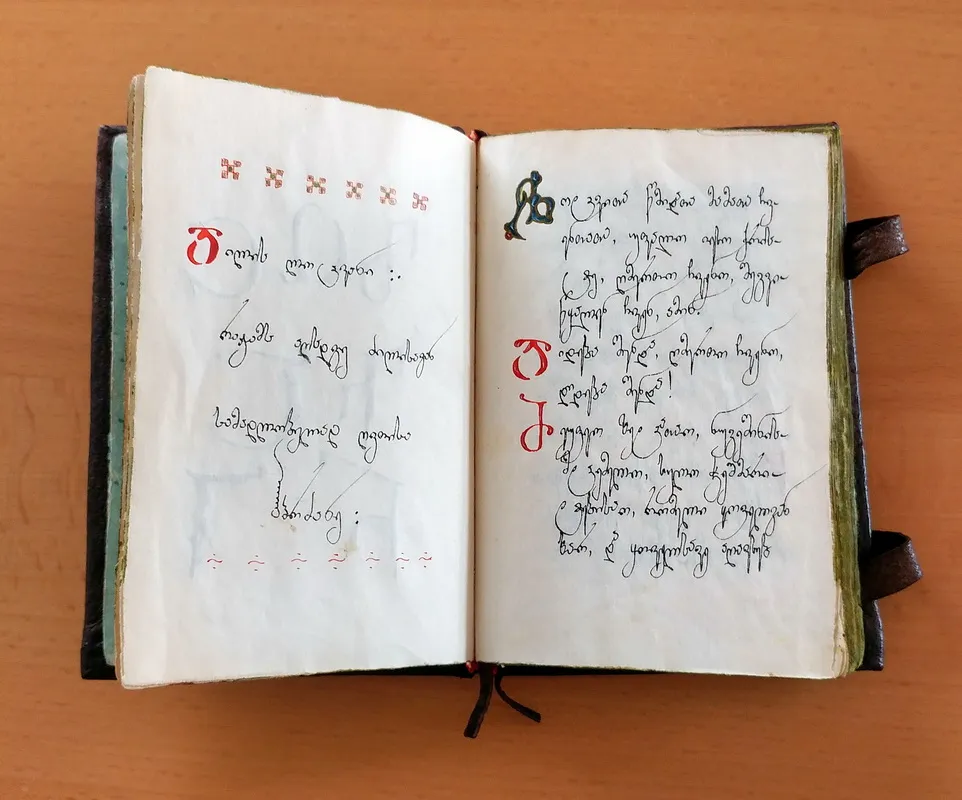
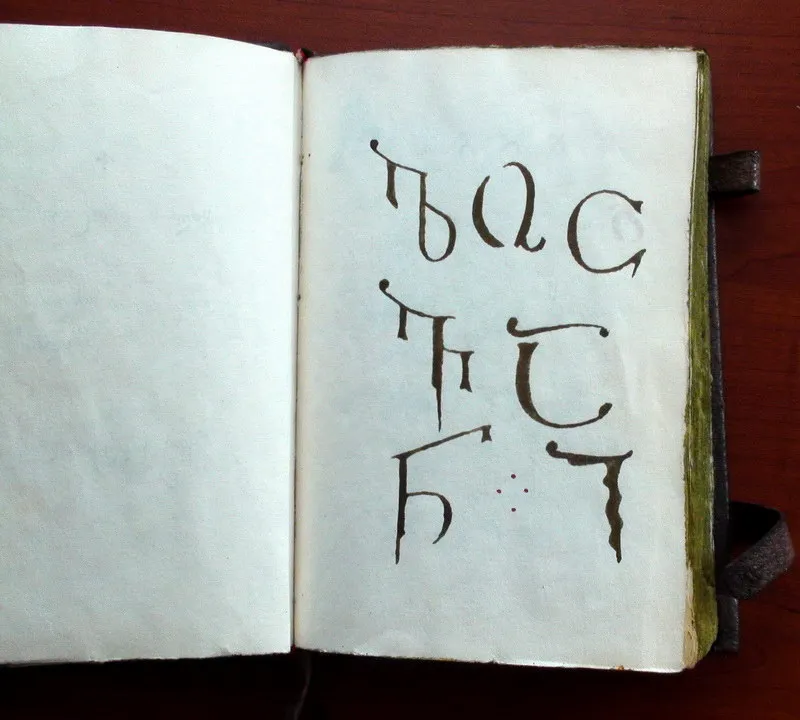
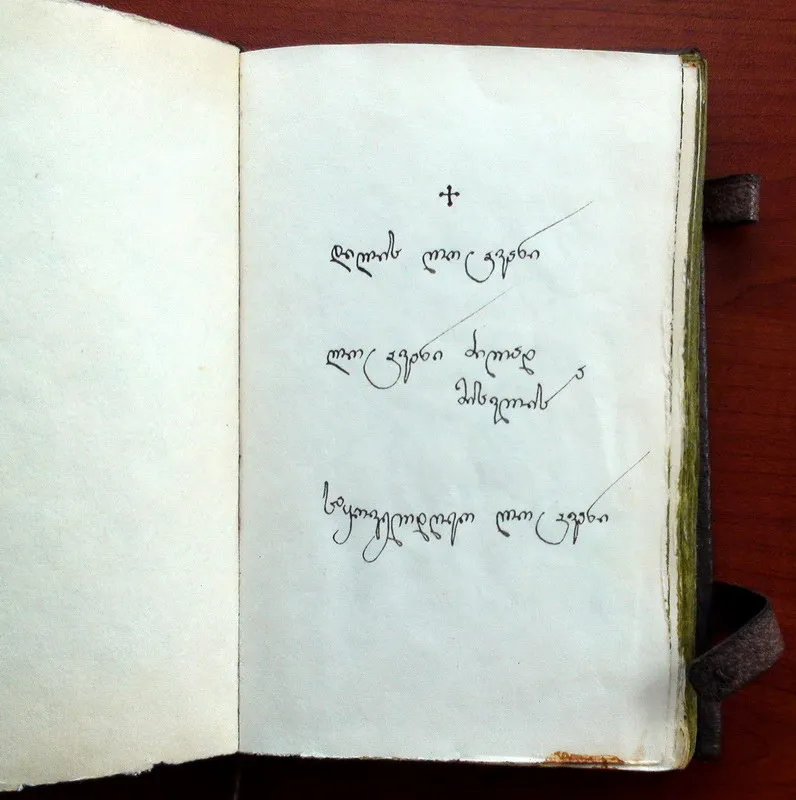
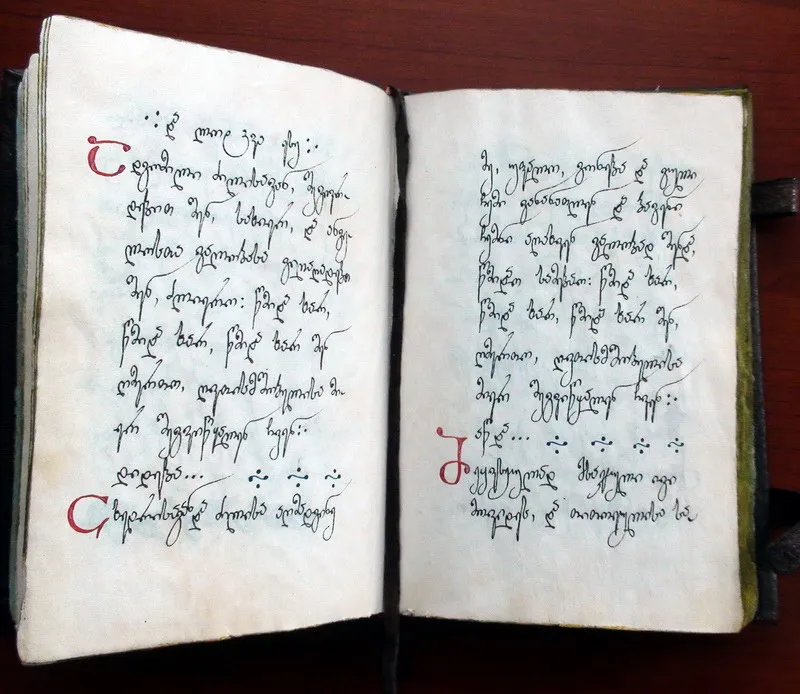
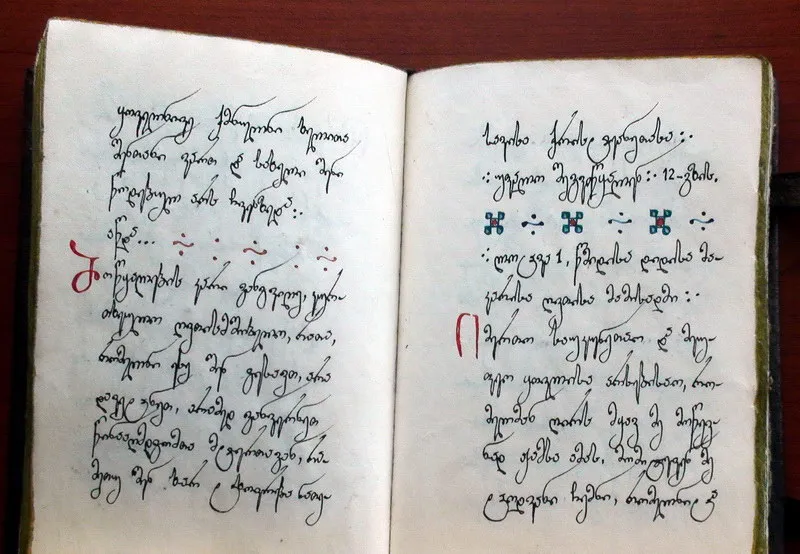
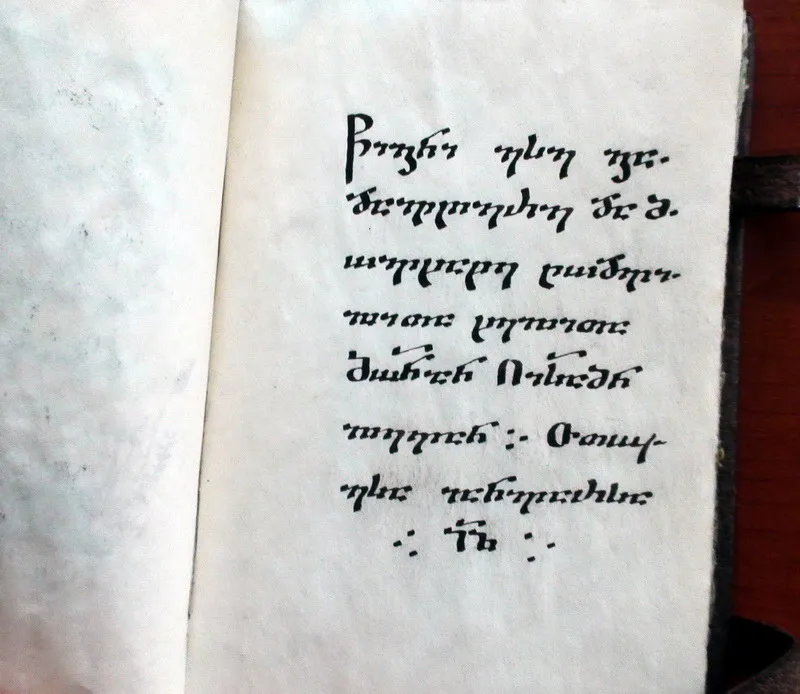
In January 1992, at the age of 26, I completed my third foundational revival manuscript — a small book of Orthodox Christian prayers — right in the middle of one of the darkest chapters of modern Georgian history. This became the third foundational book. It completed the initial revival trilogy — a quiet act of cultural and spiritual resistance during a national crisis.
Pre-history: Work at the Patriarchate
In the autumn of 1991, I began working at the Georgian Patriarchate as a calligrapher — a newly created staff position. My task was to copy the Gospel of Luke in nuskhuri script on a very large vellum sheet (approximately 105 cm high and 71 cm wide).
The project focused on creating a handwritten book containing the Four Gospels (Matthew, Mark, Luke, John). It had been initiated by Bishop Davit Alaverdeli. The project had already dragged on for years. Bishop Davit had prepared the concept, acquired the vellum, and copied the chapter of Matthew himself. Other artists — mostly painters — worked on the remaining sections. For various reasons, some participants could not continue, and new people joined, including me — now officially as a staff calligrapher.
This vellum was not the thin, refined calfskin used in ancient manuscripts. It was thick, heavy, and roughly processed — the kind intended for modern leather goods like belts, shoes, and bags. No one prepared such material for books.
Its surface felt like velvet. The flat-nibbed pen for nuskhuri did not glide smoothly. Most importantly, one stroke could not properly deposit the ink. Instead of traditional ink, Chinese ink (tush) was used — another deviation from tradition. Free, flowing writing became impossible. Each stroke required several passes to make the surface accept the ink.
I searched libraries for literature, but found no real solution. In the end, practical experiments proved most effective — and also the messiest. I mounted a sanding disc on an electric drill and began polishing the vellum surface. This took place in a small room allocated by the Patriarchate. The process raised clouds of dust. Even with a respirator over my nose and swimming goggles over my eyes, dust filled my throat and nostrils after every session.
Without the electric drill and sanding disc, hand-polishing such a large surface would have been nearly impossible. The high speed of the disc not only smoothed the vellum but also heated it. I wiped the warm surface with a damp cloth — this polished it further. The gelatin in the vellum acted like a natural primer, filling the pores.
After many days of work, the surface became almost as smooth as paper. Fast, confident writing with a quill finally became possible. I shared this method with another scribe. Soon, the sound of an electric drill could be heard from his room, echoing through the corridors of the Patriarchate building.
On the well-prepared vellum, I drew faint pencil guidelines — lines I would erase after completing the text. By December, electricity supply problems appeared. There was no heating in the room. But soon the worst began.
The Manuscript created in January 1992 — Amid Crisis
In the last week of December 1991, a military coup erupted in Tbilisi. Armed clashes broke out. Various paramilitary groups attacked the parliament building and the legitimate government inside. The fighting quickly turned the city center into a war zone. Fires broke out in nearby buildings. Gunfire echoed constantly through the streets.
I walked to the Patriarchate building through narrow side streets to collect my small salary. The Patriarchate postponed payment to January — in those days, delays of three to five months were common. Moving openly in central Tbilisi felt dangerous. I saw armed men shooting toward the parliament. Return fire came from there.
The battles continued into the first week of January 1992. By then, the isolated government had fled the capital. Chaos, destruction, and uncertainty followed. Power outages became frequent. Food shortages appeared in shops. Long queues formed for bread. Armed groups looted stores. Carjackings and extortion became common.
The brutality of reality replaced the joy of liberation from the Soviet Union. Perhaps the only thing people like me could do was pray for this suffering country.
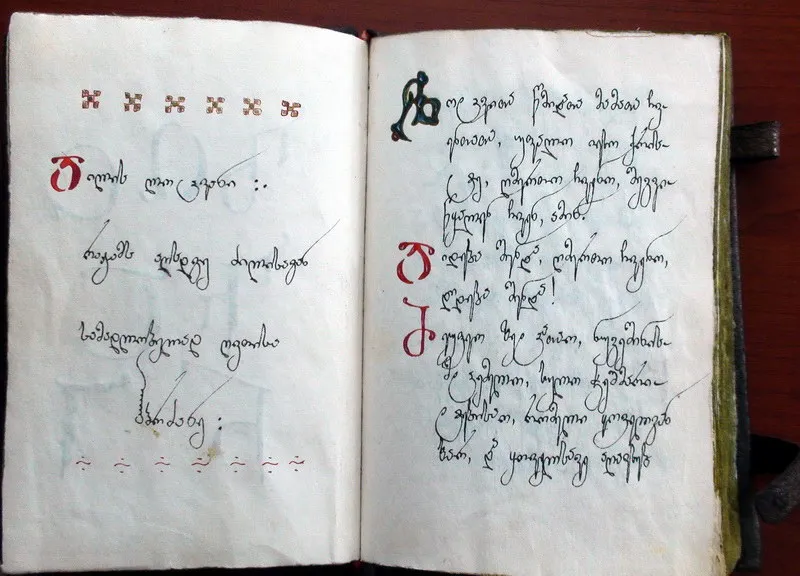
It was precisely during these days of fighting in Tbilisi that I created this small handwritten prayer book. I worked on it for one week. In the evenings, television showed terrifying footage of street battles.
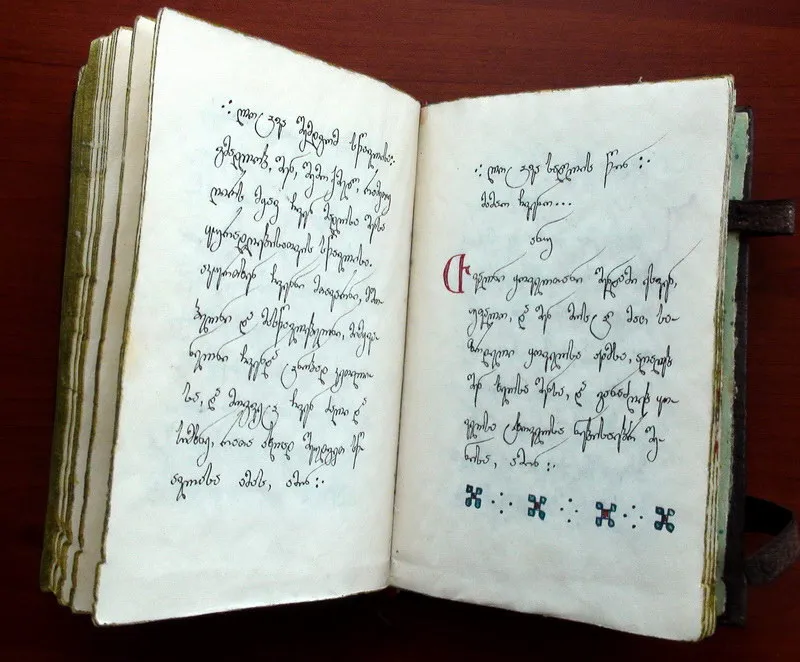
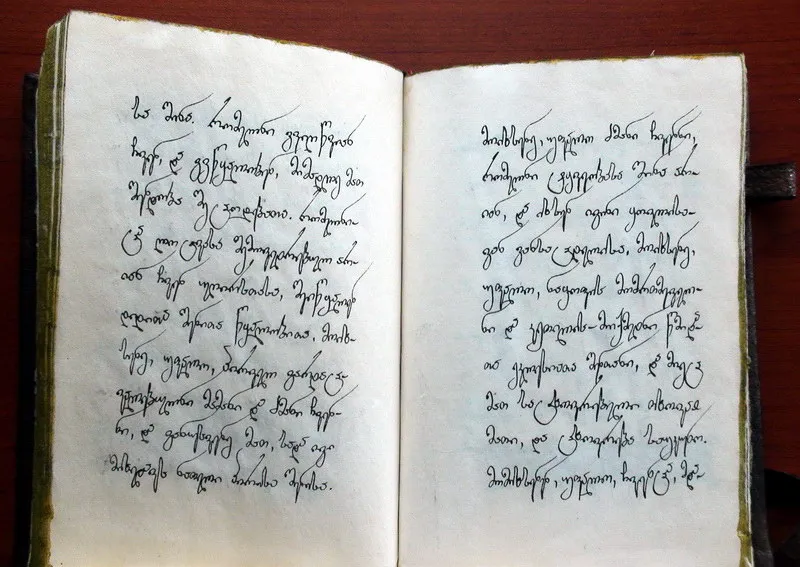
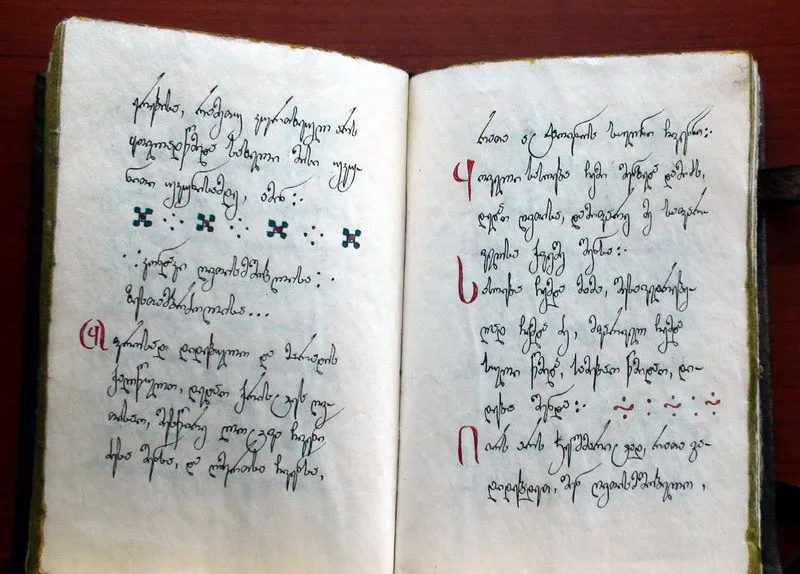
Even today, this book radiates a strange energy. Visitors feel deep emotion when they see it. Many hold it close to their heart — this modest, leather-bound volume with quick calligraphy and minimal artistic decoration. It looks as if someone stranded on a deserted island made it with the simplest tools at hand.
Technical Details and Binding Method
At home, I found good-quality paper sheets. They were thin. Paraffin treatment would have made them too translucent. So I decided to use a classic book format and traditional binding.
I cut the paper to my chosen size — final format 10 × 14 cm. This size is convenient to carry in a pocket. One sheet yielded four pages, folded as in ordinary books.
The paper had a glossy surface and was too white. This is often considered an advantage, but not for my purpose. Inspired by the vellum polishing at the Patriarchate, I experimented on this paper — much easier.
I soaked the sheets in a weak saffron infusion overnight and dried them the next day. The paper gained a wonderful texture. It lost its shine and excessive whiteness. The quill glided smoothly. Ink formed fine lines. Pale colors worked well for simple ornaments.
I bound the book by hand with traditional thread stitching. I made the leather cover using the traditional method, adding small leather straps as clasps and two thin bookmarks.