From the Artist
Creation History for the 2009 Manuscript
In August 2008, the long-standing Russia-Georgia conflict escalated into Russia’s open military aggression. This led to hundreds of casualties, ethnic cleansing, and Russia’s occupation of two Georgian regions.
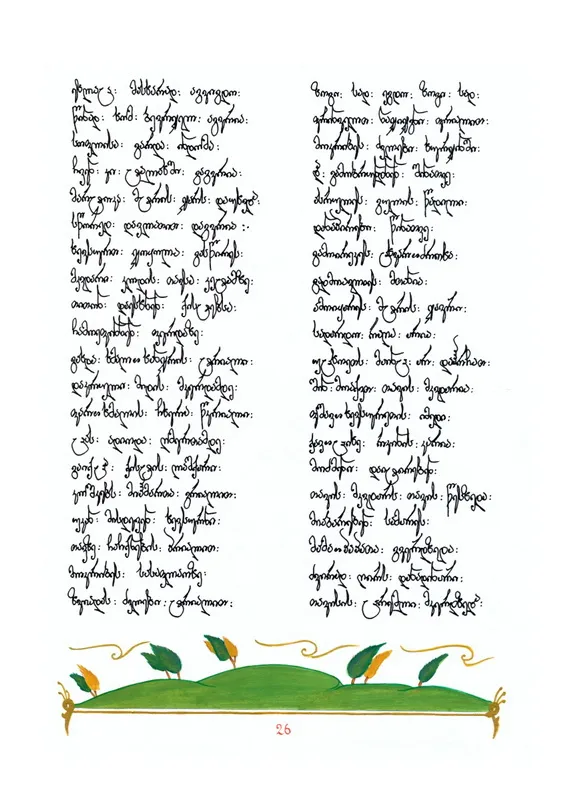
One year later, in response to these events, I collaborated with my friend in early August 2009 to create a manuscript of Vazha-Pshavela’s poem “Host and Guest”. This was our echo to the previous year’s war — to show the strength and immortality of the Georgian spirit. We also aimed to highlight the depth and importance of Georgian literature, poetry, and culture in general.
At that time, I worked in graphic design. I mastered several programs and had peripheral devices: a scanner and printer. So I planned the project in advance. Besides the manuscript, I wanted digital copies for potential publishing. I again planned the writing and illumination on one side only. This allowed high-quality scanning of each page.
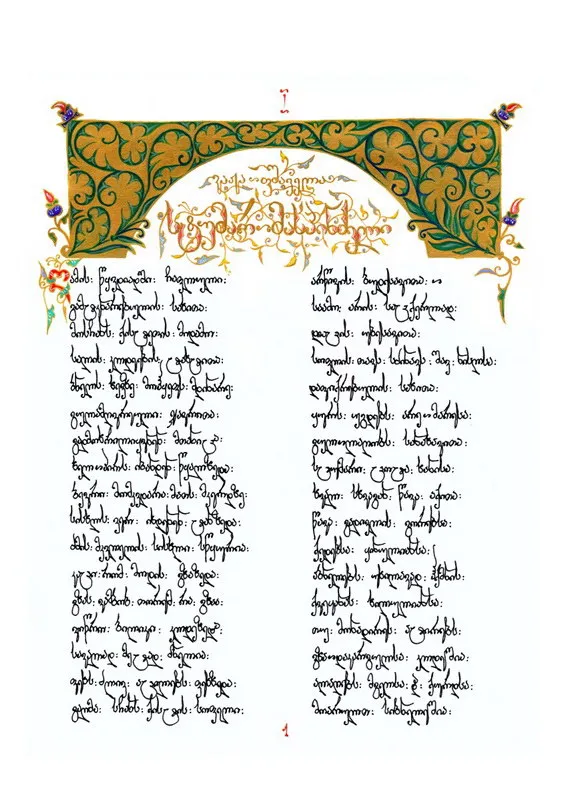
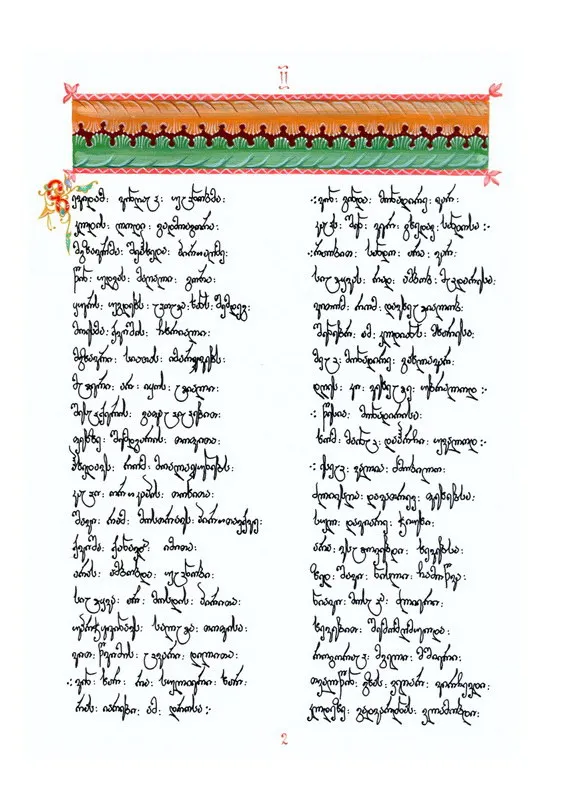
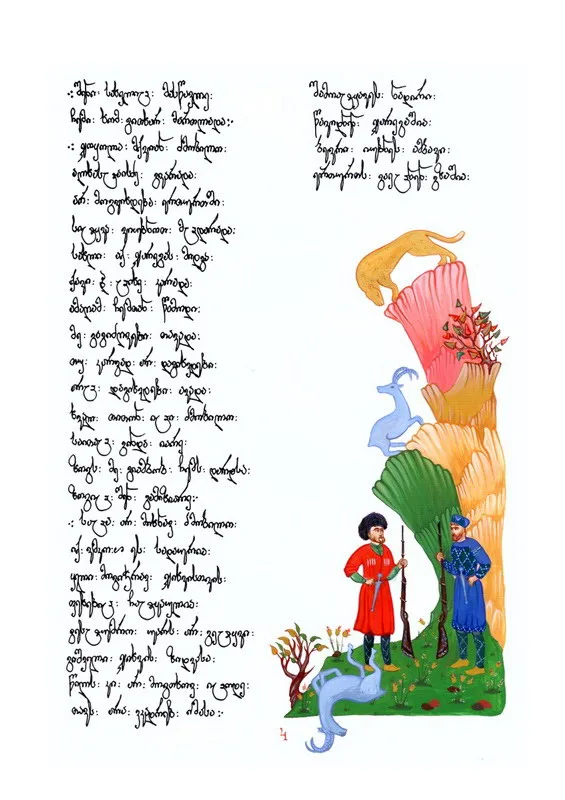
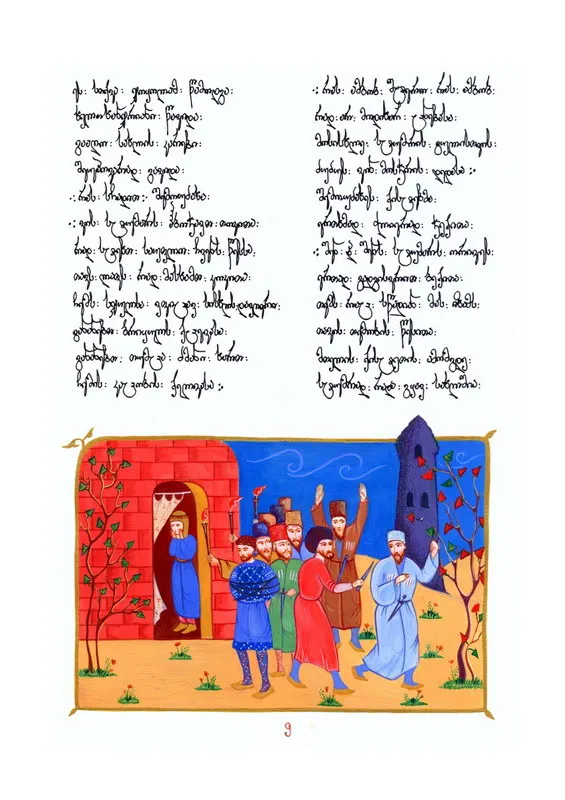
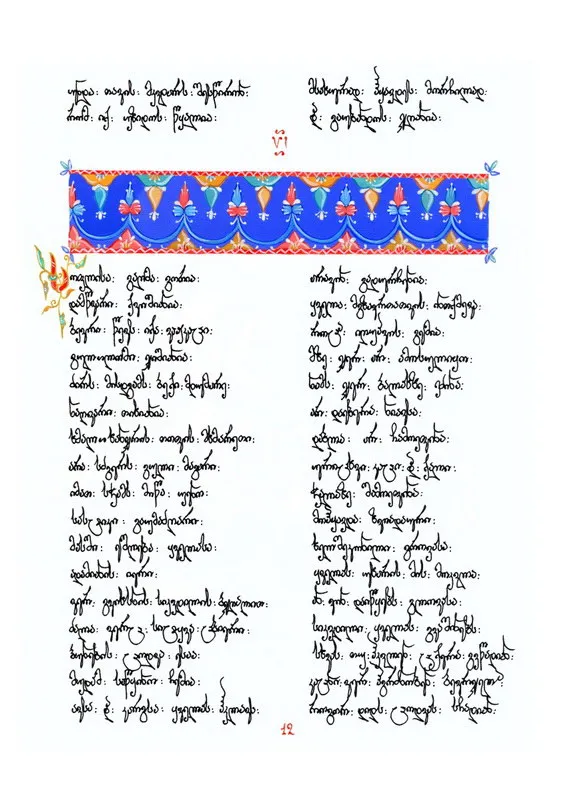
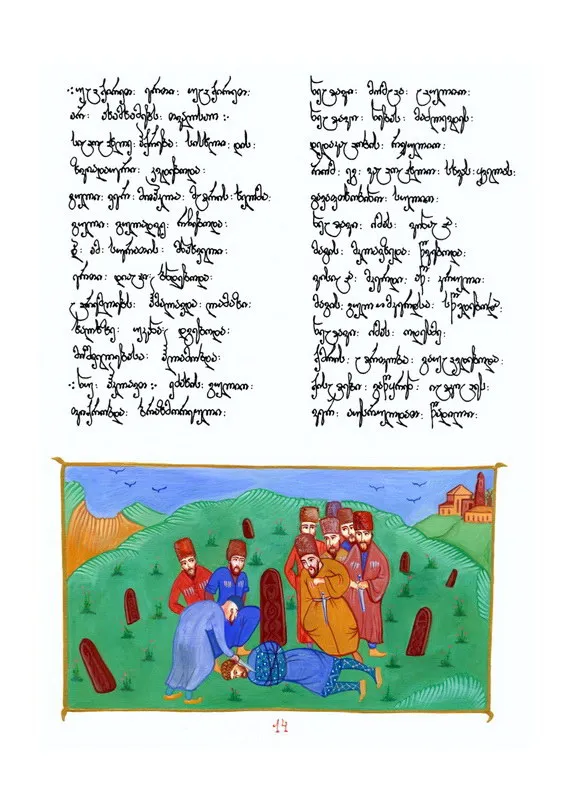
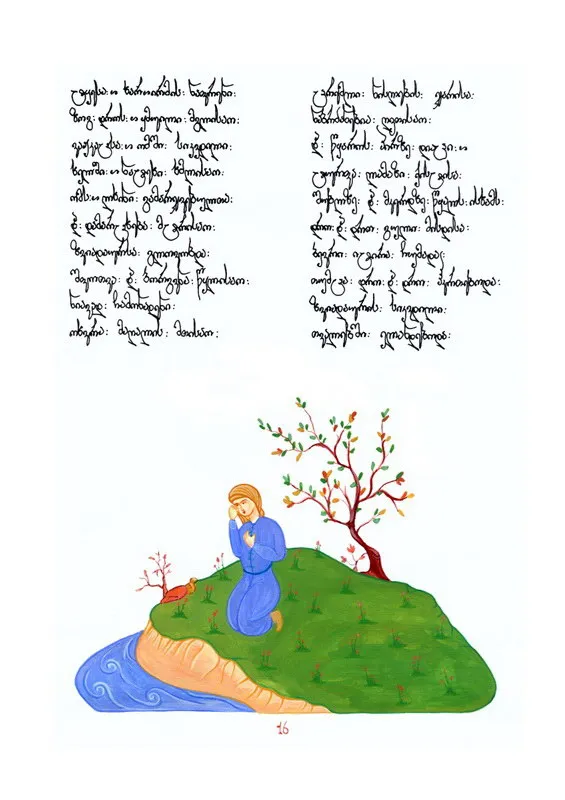
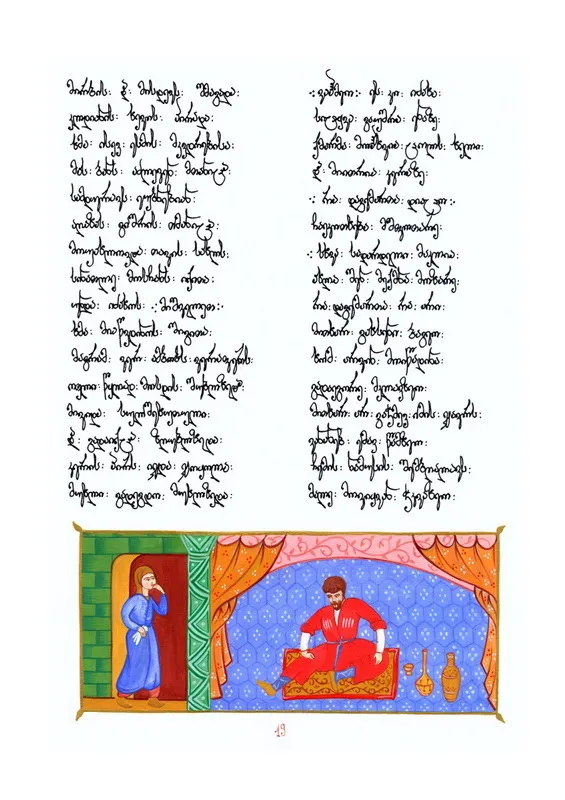
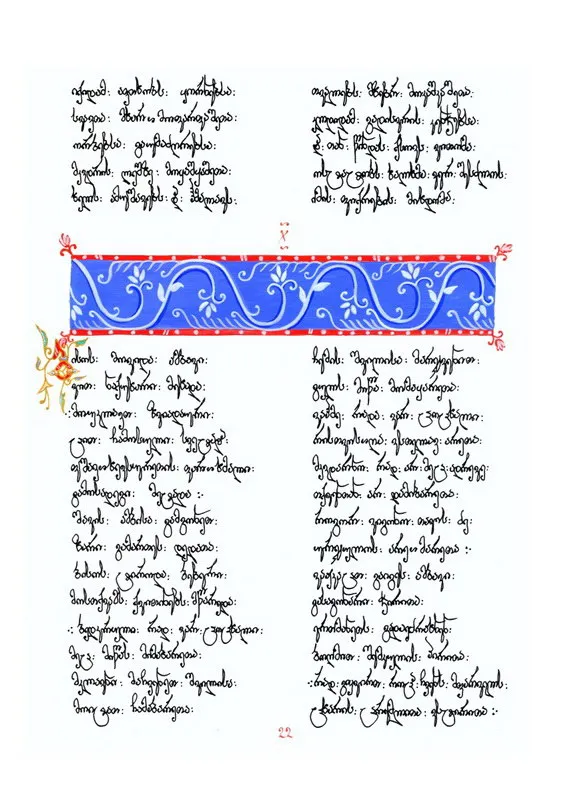
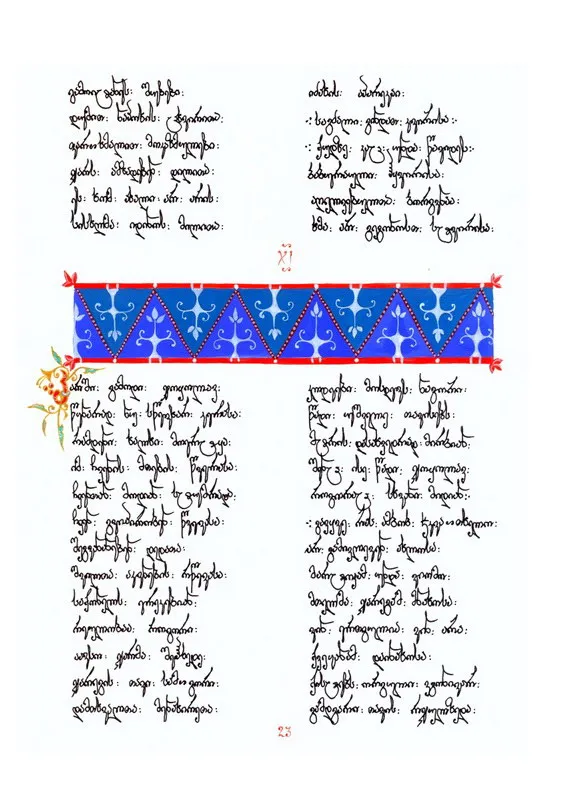
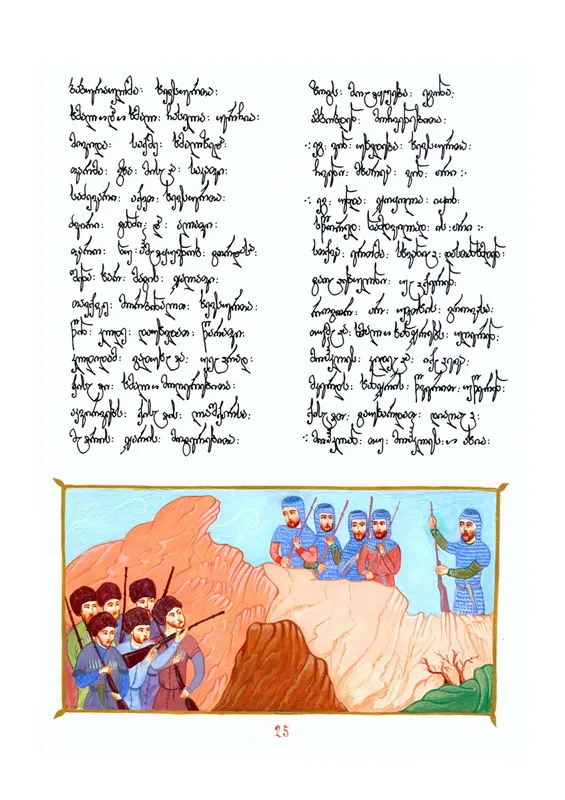
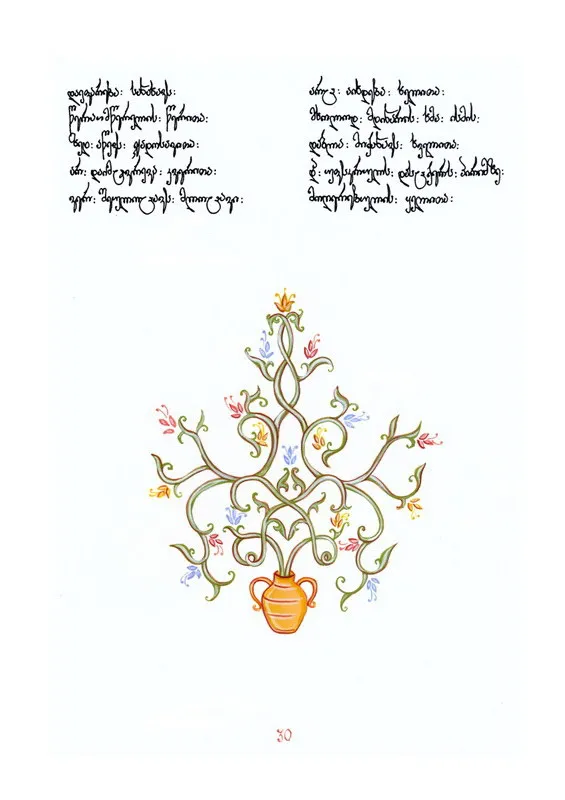
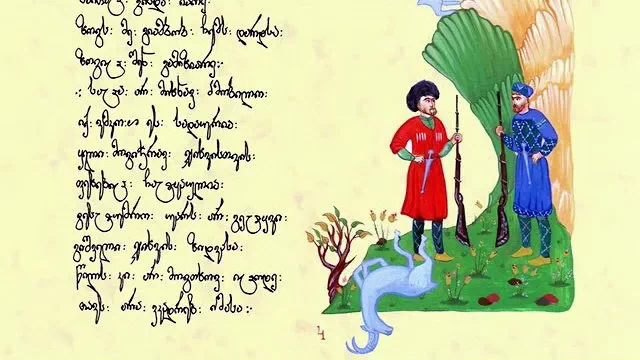
I fully planned the handwritten book’s layout. The poem is divided into numbered chapters. New chapters would start with ornamental decoration. Relevant places would have scenic miniatures.
But these miniatures should not resemble modern book illustrations. Nor should they mimic any ancient style — European or Eastern. Both miniatures and ornaments had to be completely new in expression — modern, but rooted in illuminated manuscript traditions.
After finishing the text, I painted two scenic miniatures in advance, in the layout-defined places. Of course, I tried numerous sketches and styles beforehand. Due to graphic design orders, I had little time for the book. I decided to invite a young icon painter, Ketavan Kavazauri, to the project. Such collaboration seemed interesting to me. After all, ancient manuscripts often involved teamwork.
Icon painting was already popular in Georgia. But manuscript illumination was completely unknown. Ketavan quickly mastered the style I prepared. Miniature art is close to the icon painting technique. Again, after many sketches, she completed the book’s remaining miniatures and chapter ornamental decorations.
Thus, we established the tradition of teamwork on handwritten books. This reflected in subsequent manuscripts through other participants’ involvement.
Technical Details and Representing
For the 2009 “Host and Guest” manuscript, I chose the same type of paper as for the 1990 “Nine Martyred Children of Kola” and 1991 “Abdulmesiani”. But it turned out that despite the identical name and texture, this was not the same paper produced in the Soviet Union. The new manufacturer had changed its density — probably for economic profit.
Sometimes the paper absorbed the ink and smeared. I had already drawn faint pencil lines on the sheets for straight text lines. So it was regrettable to discard them when I discovered the ink absorbed. Especially since sometimes this happened after writing 5-6 sentences.
Initially, I blamed August’s heat. While writing, I avoided touching the paper surface with my palm to prevent extra heat. I placed another paper under my palm and wrote that way.
In the end, I discarded 30 percent of the paper and suffered extra, futile labor. This was Russian-produced paper, considered high-quality. Engineers, architects, and constructors still used it. But I never used it again.
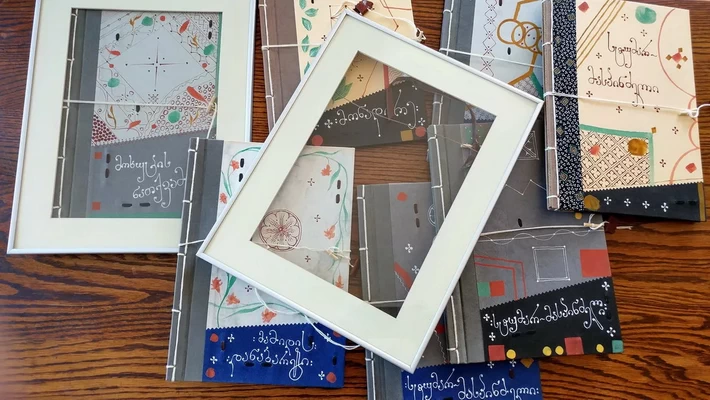
The book was not published in a print run. But I prepared up to 15 handmade copies of the manuscript: printer-printed sheets, hand-bound, with original artwork on each hard cover. Icon painter Lasha Kinchurashvili executed this artwork in tempera paint.
I did not bind the original manuscript. The single-sided sheets, as before, I treated with paraffin. I inserted them into frame-passepartouts and exhibited them multiple times at various expositions in subsequent years.
Summary of Vazha-Pshavela’s poem “Host and Guest” — Plot Overview
“Host and Guest” (“Stumar-Maspindzeli”), written in 1893 by Vazha-Pshavela, unfolds in the mountainous region of Kisteti, in the Caucasus, where neighboring ethnic communities live under a long-standing code of hostility and blood feud. Within this harsh and honor-bound world, a single act of hospitality ignites a tragic chain of events that tests the limits of loyalty, faith, and humanity.
The story begins when Jokola, a Muslim Kist, encounters Zviadauri, a Christian Khevsur, in the rocky highlands during a hunt. Jokola has successfully killed a mountain goat, while Zviadauri has returned empty-handed. Jokola offers to share his game, but the proud Khevsur refuses. Instead, Jokola invites the stranger into his home. Though fully aware that he is entering the village of his enemies, Zviadauri accepts and helps carry the hunted animal.
At Jokola’s house, his wife Aghaza receives the guest according to sacred custom: she takes his weapons, sets them aside, and lays the table. Yet the fragile peace is soon shattered. The Kists recognize Zviadauri as a feared Khevsur fighter responsible for the deaths of many of their kin, among them Jokola’s own brother. The villagers storm the house and seize him.
For Jokola, the matter transcends revenge. A guest under one’s roof is inviolable. To violate that law is to dishonor the host. Defending this sacred principle, Jokola demands Zviadauri’s release and, in the struggle, kills one of his fellow villagers. The enraged Kists bind Jokola and drag Zviadauri to the grave of the recently slain man, intending to sacrifice him as a servant for the afterlife. Zviadauri meets death fearlessly, refusing to submit to humiliation, and thus disrupts the ritual. Furious and defeated in spirit, the villagers leave his body unburied, exposed to dogs and birds beneath the open sky.
Moved by compassion, Aghaza secretly goes to the graveyard at night. She drives away the scavengers with stones and mourns the fallen warrior, not as an enemy, but as a lonely human being with no one left to weep for him. Haunted by visions of the dead condemning her act — even the angry spirit of her own brother — she returns home in fear. At first, she lies to Jokola, claiming demons crossed her path, but ultimately confesses that she shed tears for Zviadauri out of pity. Jokola does not condemn her. On the contrary, he acknowledges that a brave man is always worthy of a woman’s mourning.
Zviadauri’s death sparks retaliation: the Khevsurs attack the Kist village. Knowing he is now rejected by his own people, Jokola fights alone against the invaders and is killed. The Kists forbid his burial in their cemetery. Aghaza lays her husband to rest upon a cliff and, in despair, throws herself into the swollen river below.
Yet the poem does not end in darkness alone. On the cliff where Jokola fell, people claim that his spirit appears at night, calling out to Zviadauri. The two former enemies meet as friends, greeting one another in peace. Aghaza, too, rises there, spreading a table, roasting mountain goat over the fire. They speak of courage, brotherhood, and the sacred law of host and guest. And whoever beholds this vision cannot look away, so compelling is the harmony that transcends earthly hatred.
Major Themes in “Host and Guest”
1. The Sacred Law of Hospitality
At the heart of the poem lies the ancient Caucasian code of hospitality — a moral law older and stronger than political borders or tribal hatred. Once a stranger crosses the threshold as a guest, he becomes inviolable. Jokola’s tragedy begins the moment he chooses to honor this sacred duty over the expectations of his community. For him, hospitality is not courtesy but an absolute ethical commandment. By defending his guest, even at the cost of blood, he affirms a universal moral order that transcends clan loyalty.
2. Honor vs. Conscience
The central dramatic tension arises from the clash between collective honor and individual conscience. The villagers act according to the logic of vengeance and communal justice. Jokola, however, listens to an inner voice — a personal sense of righteousness that contradicts the tribe’s demands. The poem asks a timeless question: Is true honor found in obedience to tradition, or in fidelity to one’s own moral truth? Jokola’s defiance isolates him, yet elevates him morally.
3. Religious and Cultural Divide
The encounter between Jokola and Zviadauri is framed by religious difference — Muslim Kist and Christian Khevsur — reflecting the historical complexities of the Caucasus. Yet Vazha-Pshavela refuses to reduce the conflict to theology alone. The poem suggests that shared human virtues — courage, dignity, loyalty — outweigh doctrinal divisions. In death, the two warriors are reconciled beyond the boundaries that separated them in life.
4. Humanism and Compassion
Perhaps the most moving expression of humanism appears in Aghaza’s quiet act of mourning. She weeps for an enemy because he is alone. Her compassion challenges the rigid moral codes surrounding her. Through her, the poem asserts that empathy is not weakness but moral strength. In a world governed by revenge, her tears become an act of spiritual resistance.